The ways to generate sounding-video
Trends: From multi-stage to end2end.
| IO Pattern | Approach | Input | Output | Official demo | Comment | |
|---|---|---|---|---|---|---|
| Multi-stage |
Audio->Video Most with lip-sync |
LatentSync |
Video/Image (Extend to video) Audio |
Video |
Link |
Lip-edit in video Pixel 512*512 only |
| Hallo2 | Image Audio [opt.] Text: emotion control (calm, angry) |
Video | Link |
Extremely long video generation Not good performance |
||
| HuMo |
Text [opt.] Audio [opt.] Image |
Video | Link | |||
| LongCat-Video-Avatar |
Text Audio [opt.] Image |
Video |
Link | Long video generation SoTA |
||
| Video->Audio Only for ambient, no lip-sync |
MMAudio | Video [opt.] Text |
Audio | Link | ||
| EchoFoley | Video [opt.] Text |
Audio | Link | |||
| End2End | Text -> Audio-Video |
UniVerse-1 |
Image (As first frame) Text |
Sounding video |
Link | A valuable try No pretraining |
| OVi |
Text [opt.] Image |
Sounding video |
Link | SoTA | ||
| JoVA Closed-source |
Text [opt.] Image |
Sounding video |
Link | SoTA? |
Preliminaries
Video: From raw to latent (Wan2.1)
Components: 3D-VAE, umT5, DiT.
Video dataflow
Raw video file: (3, T, H, W)
3D-VAE: (3, T, H, W) -> (16, T/4, H/8, W/8)
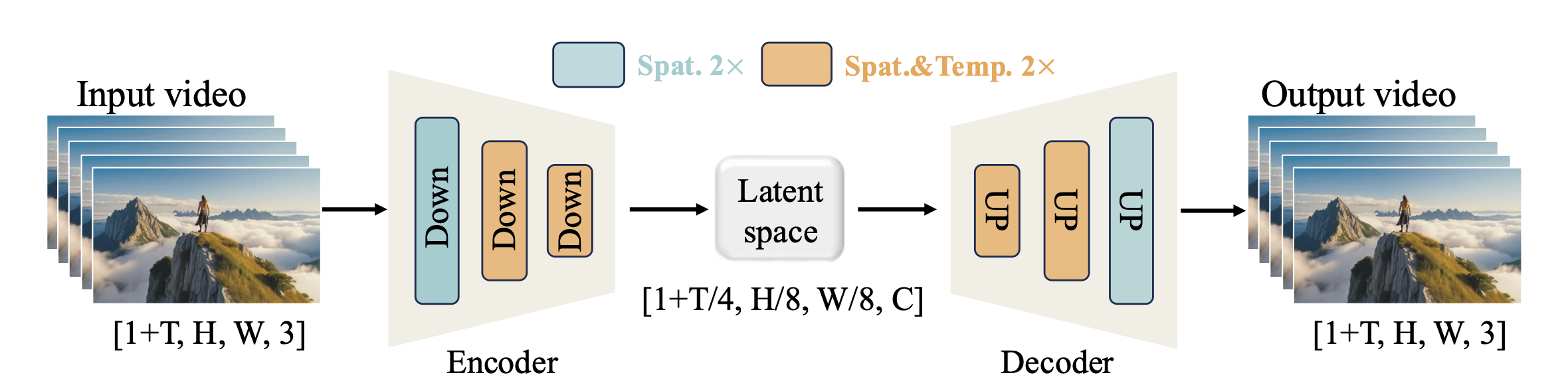
    - Upsample channel: \(3\-\>128, T, H, W\)

    - Upsample channel, downsample Temporal\+Spatial: \(128\-\>256, T\-\>T/2, H\-\>H/2, W\-\>W/2\)

    - Upsample channel, downsample Temporal\+Spatial: \(256\-\>512, T/2\-\>T/4, H/2\-\>H/4, W/2\-\>W/4\)

    - Downsample Spatial: \(512, T/4, H/4 \-\> H/8, W/4 \-\> W/8\)

    - Compress: \(32, T/4, H/8, W/8\)

    - Deterministic sample: Chunk on channel dim, use half vector as mu

- Patchify: Kernel size \(1,2,2\) \-\> \(16, T/4, H/8/2, W/8/2\)

    - Each patch contains 64 float numbers\. Use a MLP to map patch into real tensor\.

    > nn\.Conv3d\(in\_channels=16, out\_channels=D, kernel\_size=\(1,2,2\), stride=\(1,2,2\)\)
    >
    >

- Final shape: \(B, L, D\), where L=T/4 \* H/8/2 \* W/8/2
Compress ability: VAE 256x, Patchify 4x = 1024x
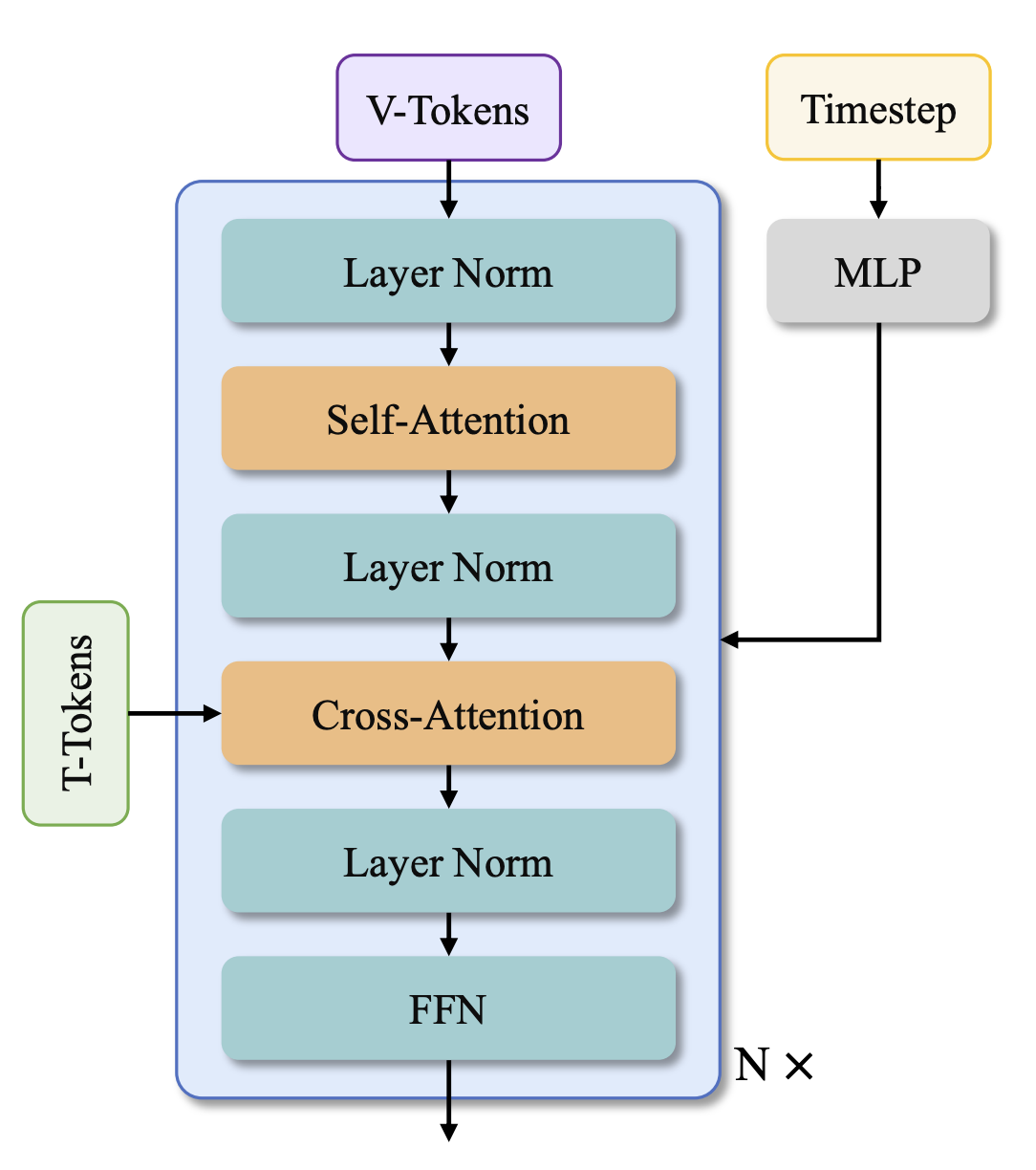
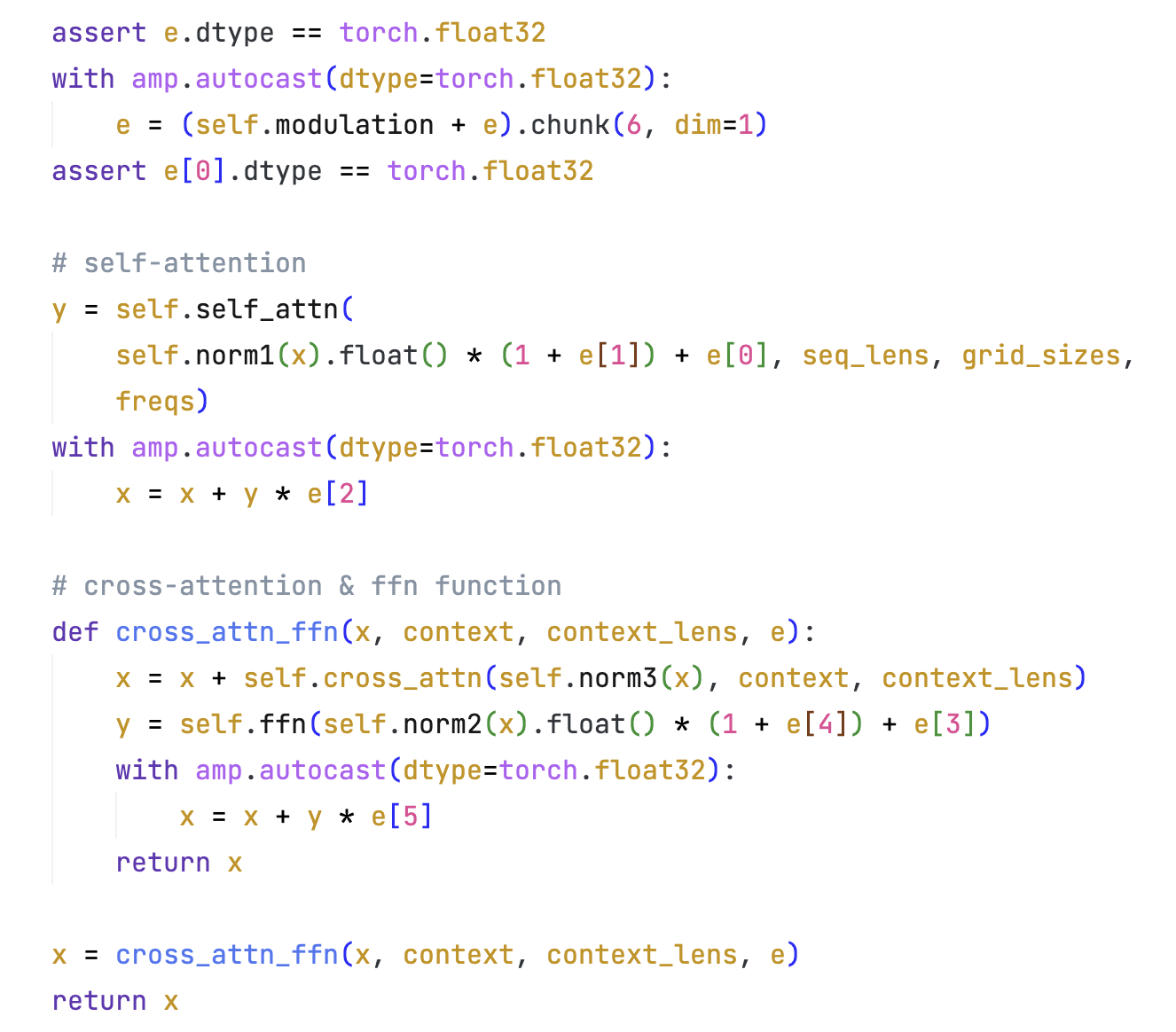
Transformer block:
Audio: From raw to latent (AceStep)
Learning from scratch
What is a sound?
The audio signal changes over time: air pressure. To capture this information digitally, we can sample air pressure over time.
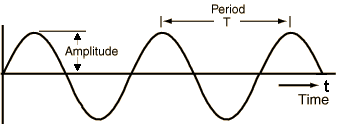
Sound freq: 1 / Period

Most sounds in life do not follow a simple \& regular periodic pattern. Signals of different frequencies can be added together to form a composite signal.
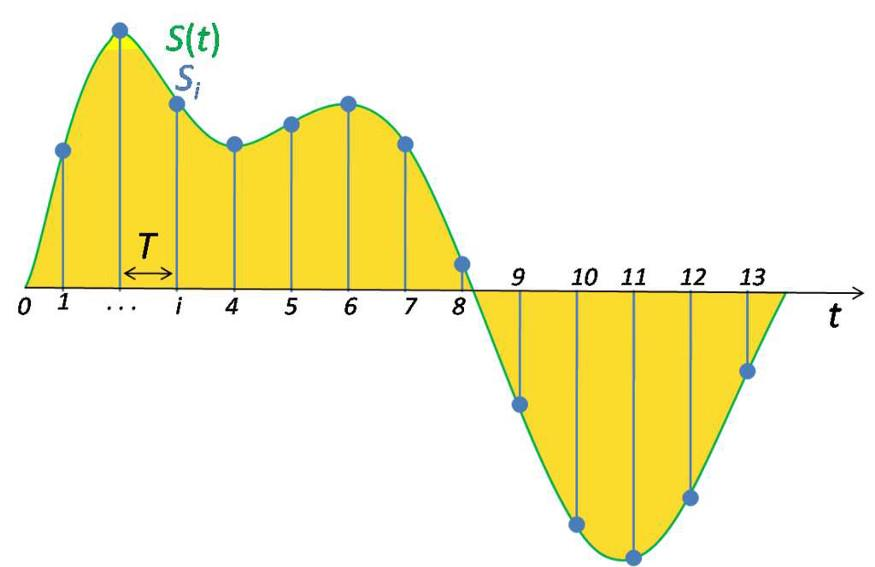
The rate can vary, but the most common is 44.1KHz(CD). Others can be 8KHz(phone), 11025Hz(AM radio), 22050(FM radio), 96KHz(DVD), etc.
How to represent a sound using a spectrum?
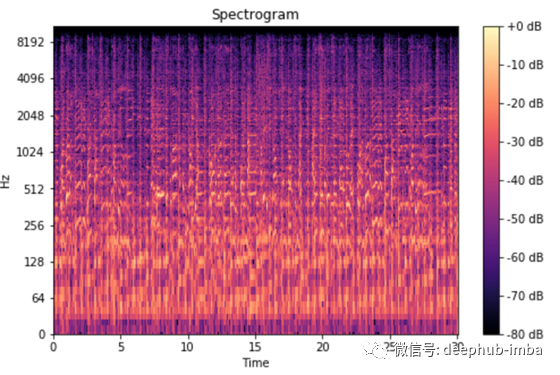
From time-axis to frequency-axis: the spectrum, another way to represent audio signal.
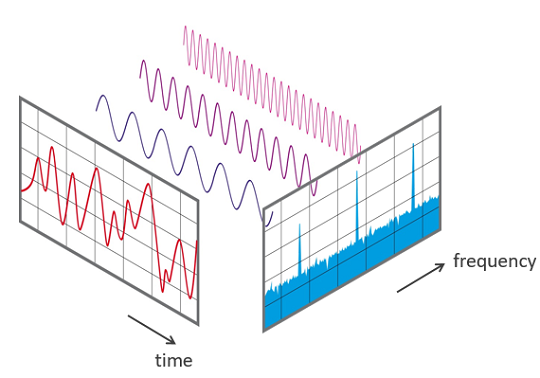
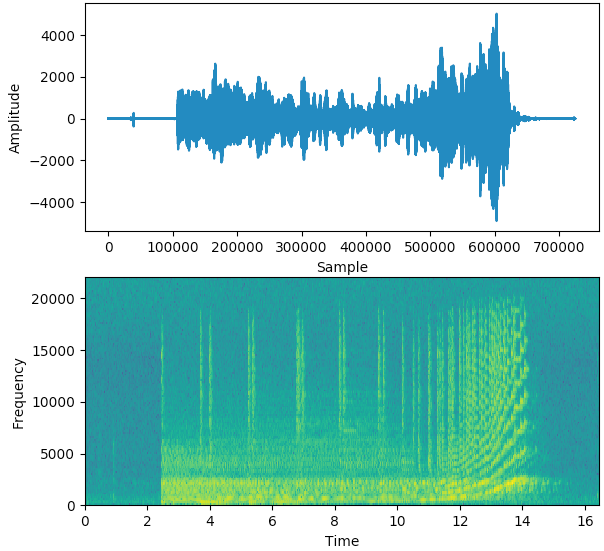
However, spectrum still needs a time-axis, because the voice changes from time to time, the spectrum can only represent a very short time.
How to generate spectrogram from signal?
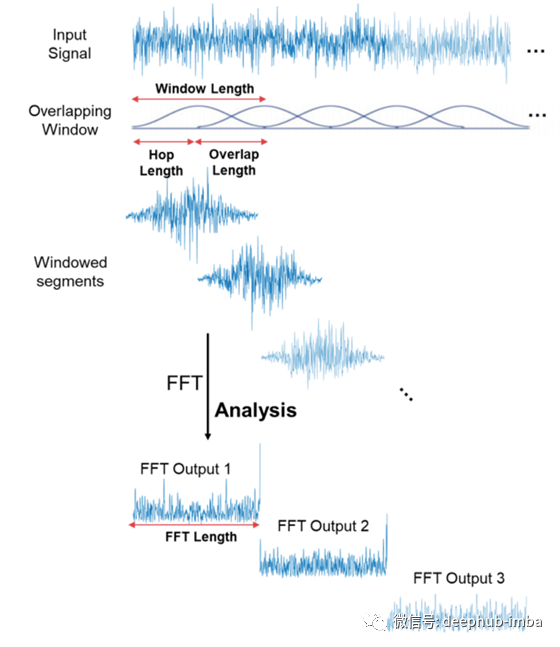
Fourier theorem: Any complex periodic signal can be decomposed into a superposition of a series of sine waves (or complex exponential functions) with different frequencies, amplitudes, and phases.
Fast Fourier Transform: analyse signal components, split signal into different frequencies.
What is Mel spectrogram?
Research shows that humans cannot perceive frequencies within a linear range. We are better at detecting low-frequency differences than high-frequency differences. For example, we can easily distinguish the difference between 500 Hz and 1000 Hz, but even at the same distance, we have difficulty distinguishing the difference between 10,000 Hz and 10,500 Hz.
In 1937, Stevens, Volkmann, and Newmann proposed a unit of pitch so that equal pitch intervals sounded equal to the listener. This is called the mel scale. We perform mathematical operations on frequencies to convert them to the mel scale.
Audio dataflow
Raw audio: [2, sample_rate * seconds, eg. 16384*1]
STFT(Hop length=512)
- [2, 1024, 32=16384/512]
scale to Mel Spectrogram: [2, 128, 32]
Audio VAE: [channel=8, 128/8, 32/8]
Patchify
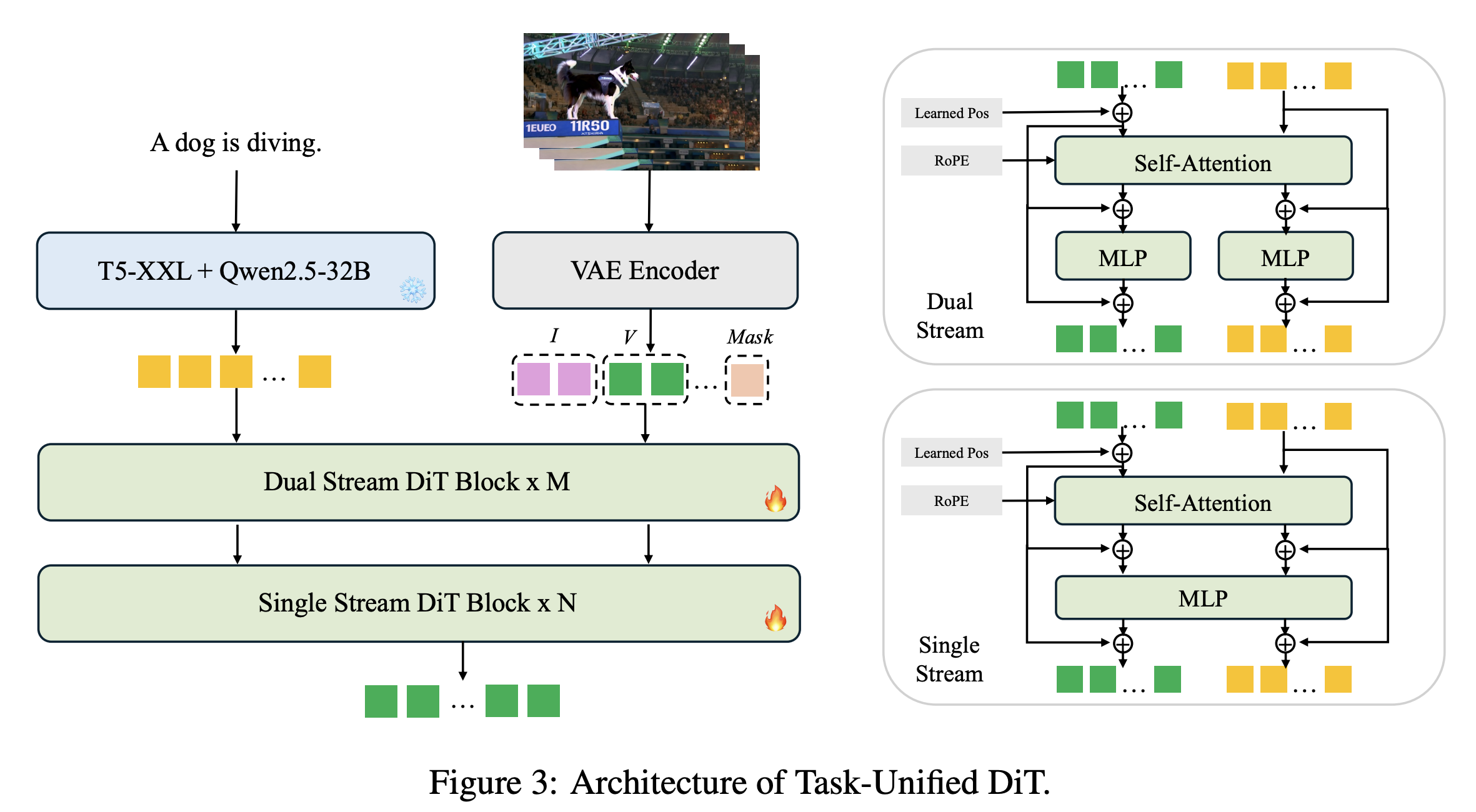
Model structure gallery
Conditional on cross attention layer
Pre-train-capable: in one cross attention block
Post-train-only: insertion of another attention block
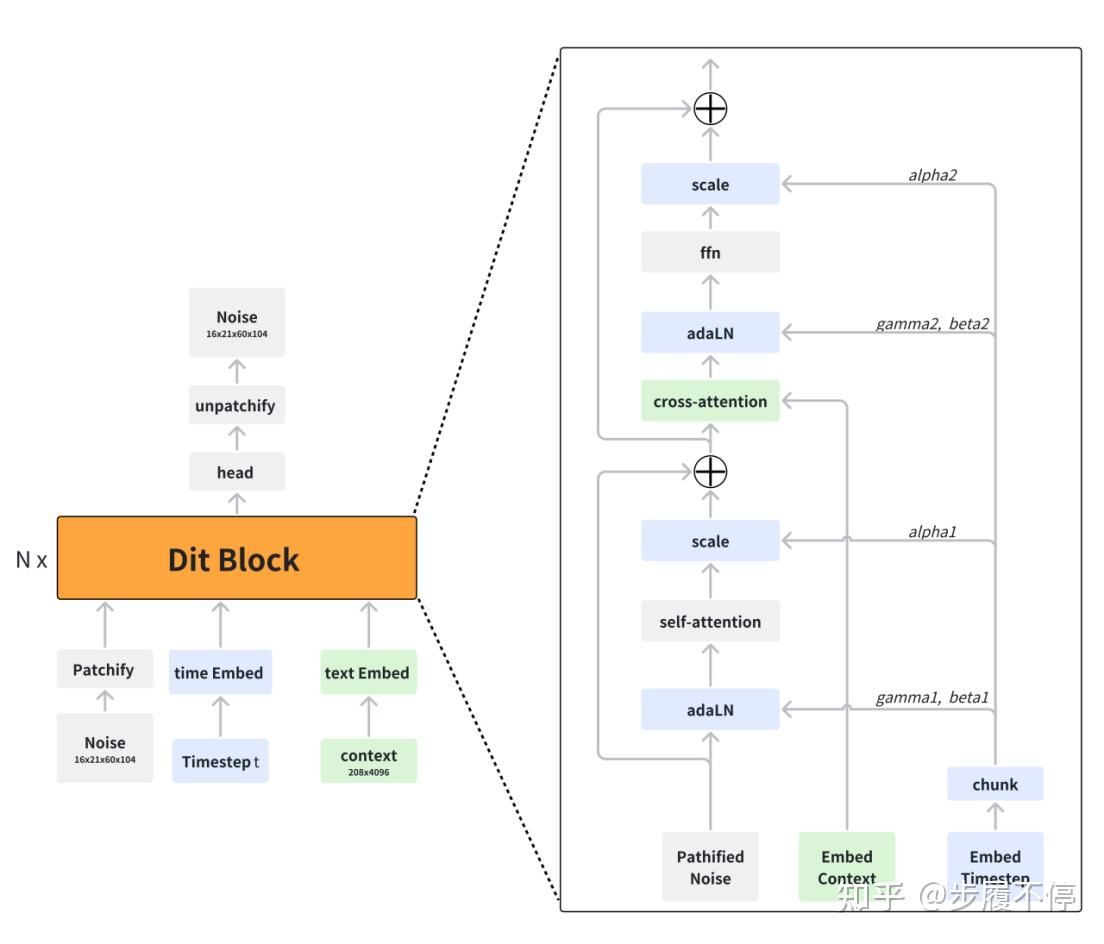
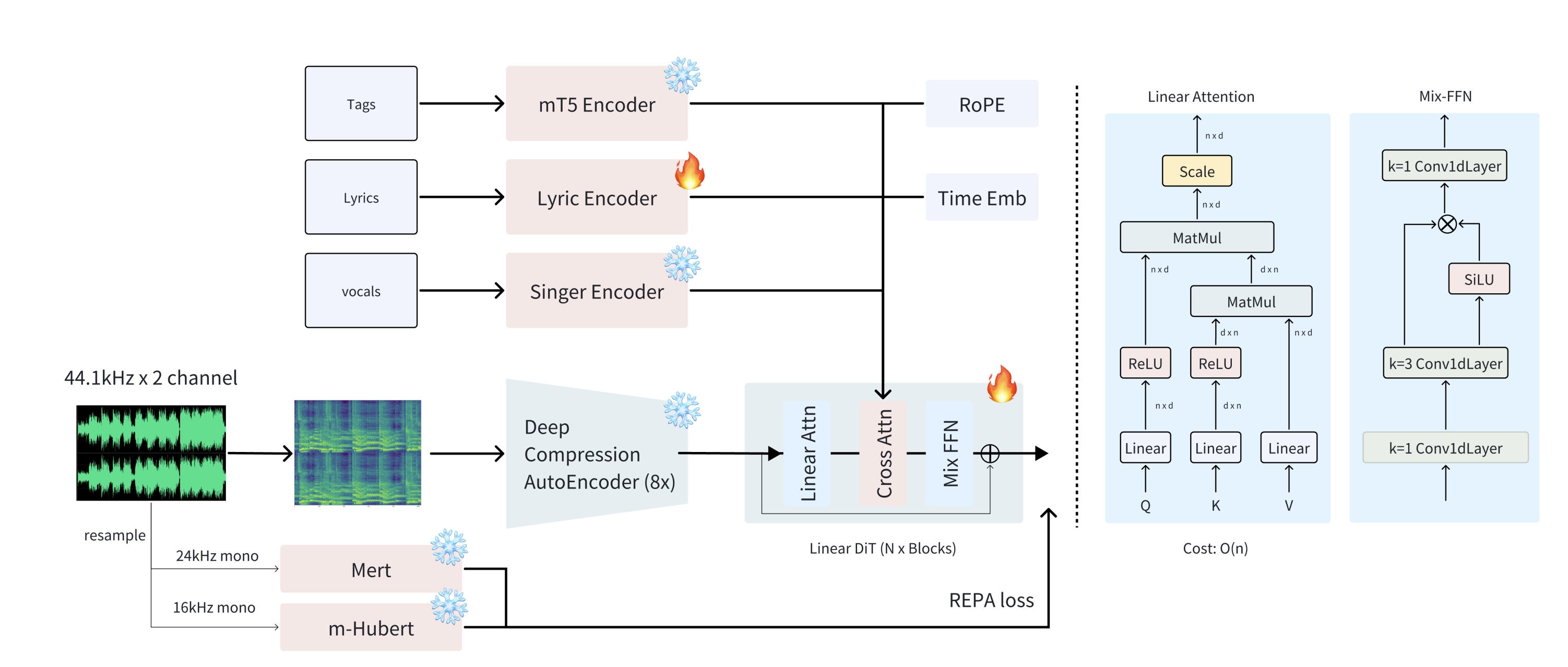
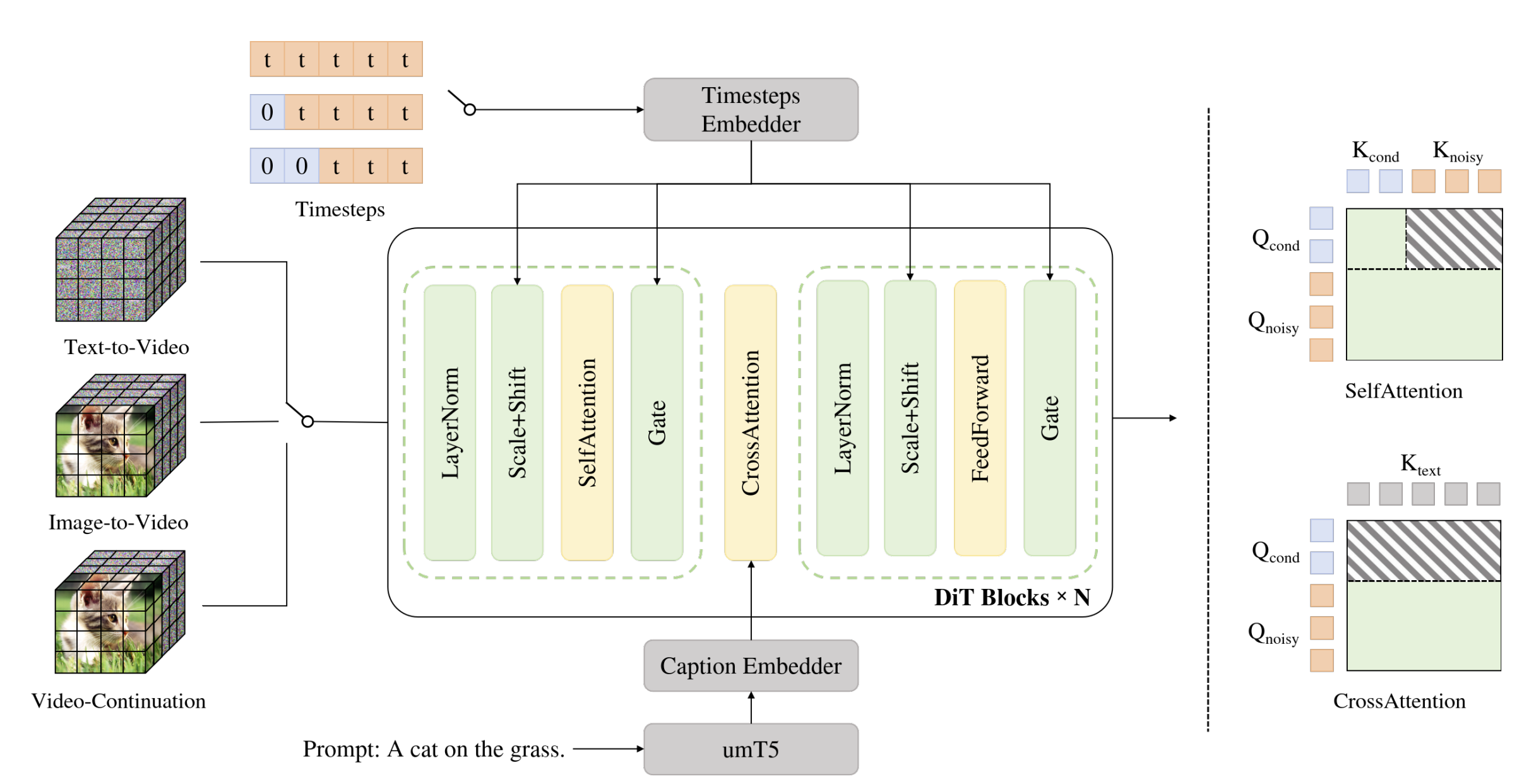
However, Waver is different.
Multi-condition example:
Train object: Flow Matching
Given a noise sample $x_0\sim p_0$ and a data sample $x_1\sim p_1$, a simple linear interpolation path is defined for time $t$:
$\begin{equation}
x_t=(1-t)x_0+tx_1
\end{equation}$
The target velocity vector along this path is constant: $u_t=x_1-x_0$. The model $v_{\theta}(x_t,t,c)$conditioned on $c$, is trained to predict this vector by minimizing the following L2 loss:
$\begin{equation}
L_{\text{FM}}=\mathbb{E}_{t\sim U(0,1),x_0\sim p_0,x_1\sim p_1}[||v_{\theta}((1-t)x_0+tx_1,t,c)-(x_1-x_0)||^2]
\end{equation}$
This objective directly trains the model to learn the vector field that maps noise to data, which leads to more stable and efficient training compared to traditional score-matching objectives.
End2End
Challenges: alignment
Time Alignment
Physical Distortion: The sound of a glass breaking does not match the visual transient.
Temporal Drift: The speaker’s lips close, but the voice continues (Lip-sync failure).
Semantic Alignment: The visual shows a heavy truck, but the sound is a light sedan.
Important aspects
Data curation
Fusion
Audio-video temporal alignment
In-model interaction
Joint Audio-Video Generation
Multi-modal CFG

UniVerse-1
https://arxiv\.org/abs/2509\.06155
Main idea: Stitching of Experts
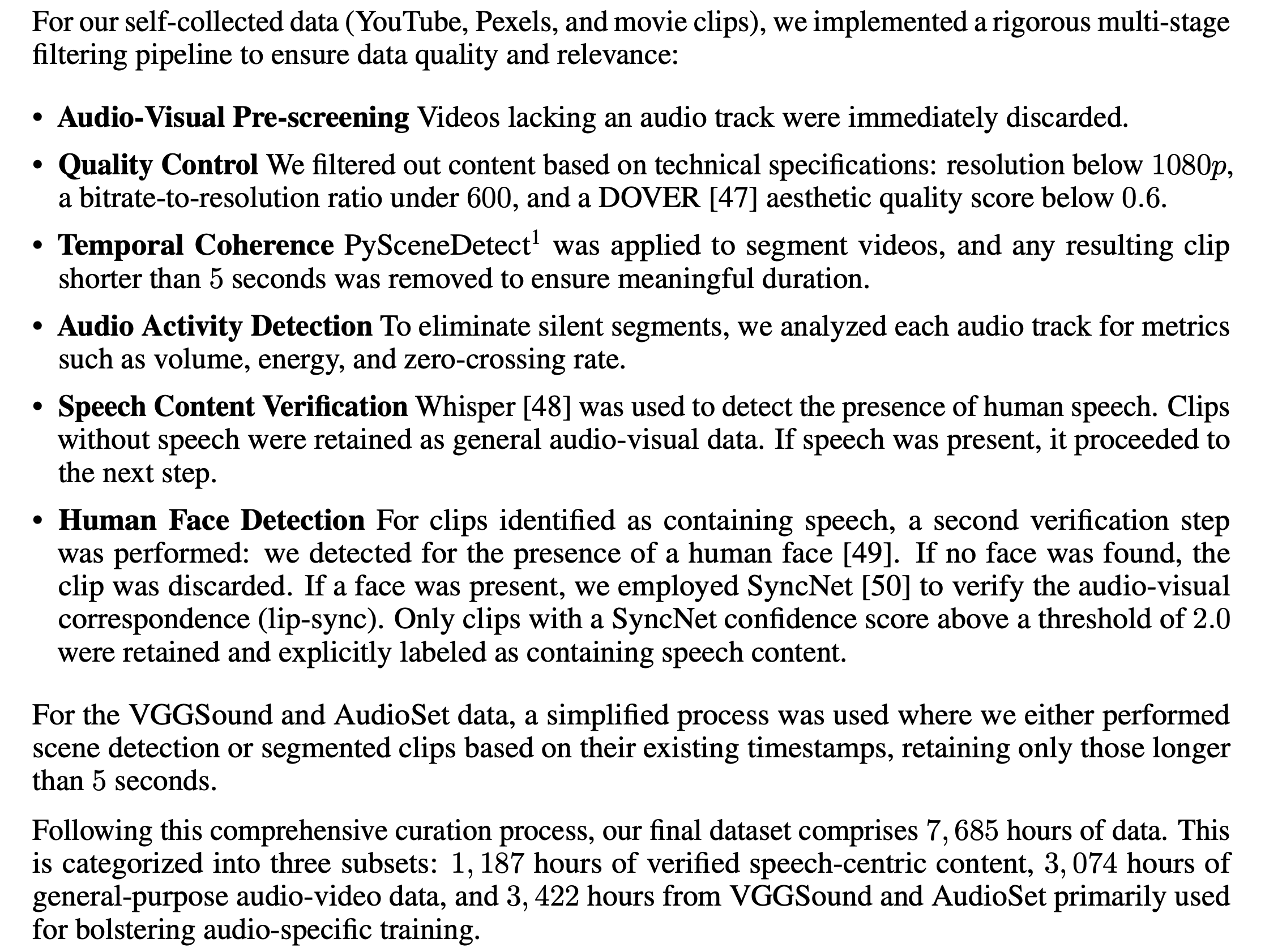
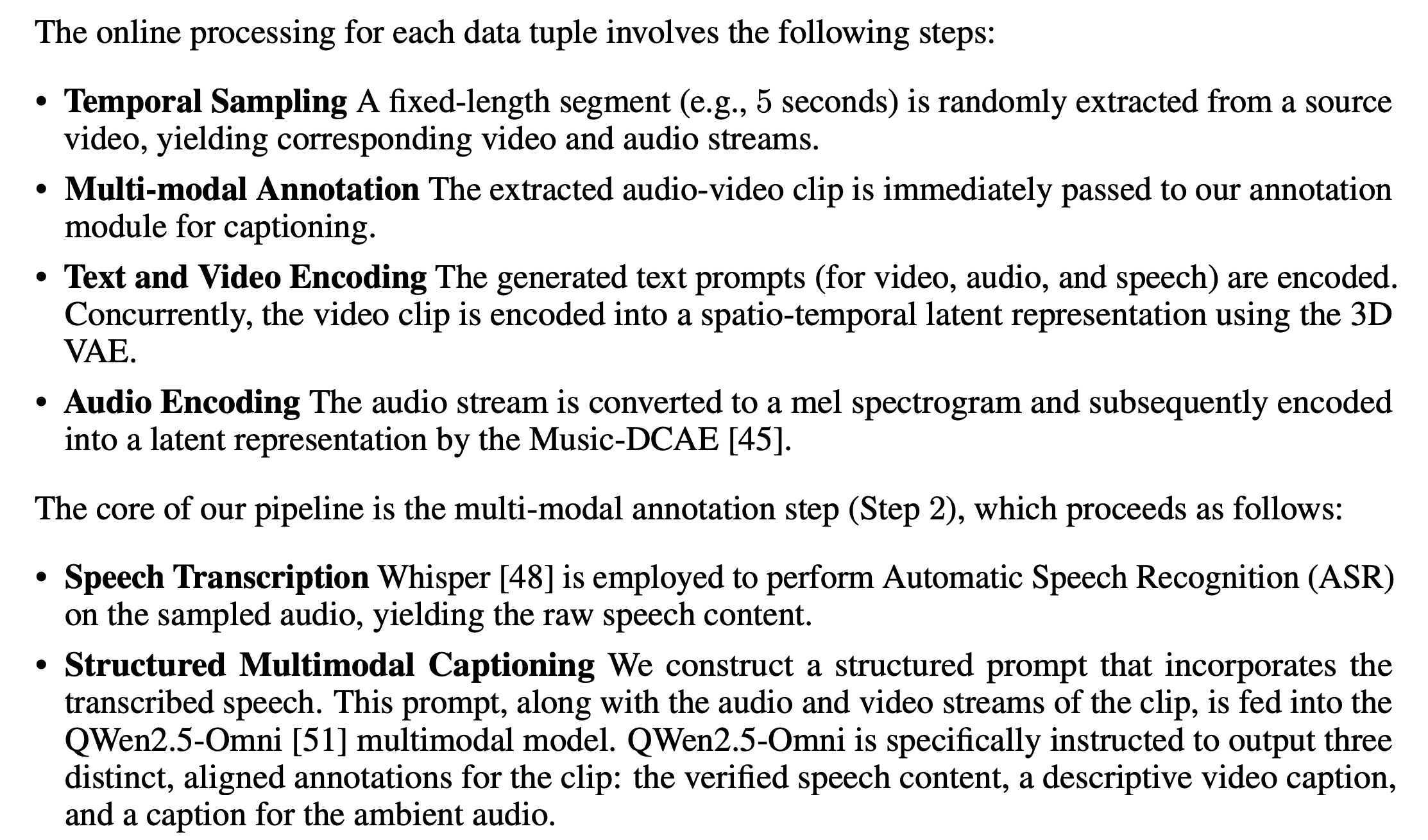
Data **Curation**
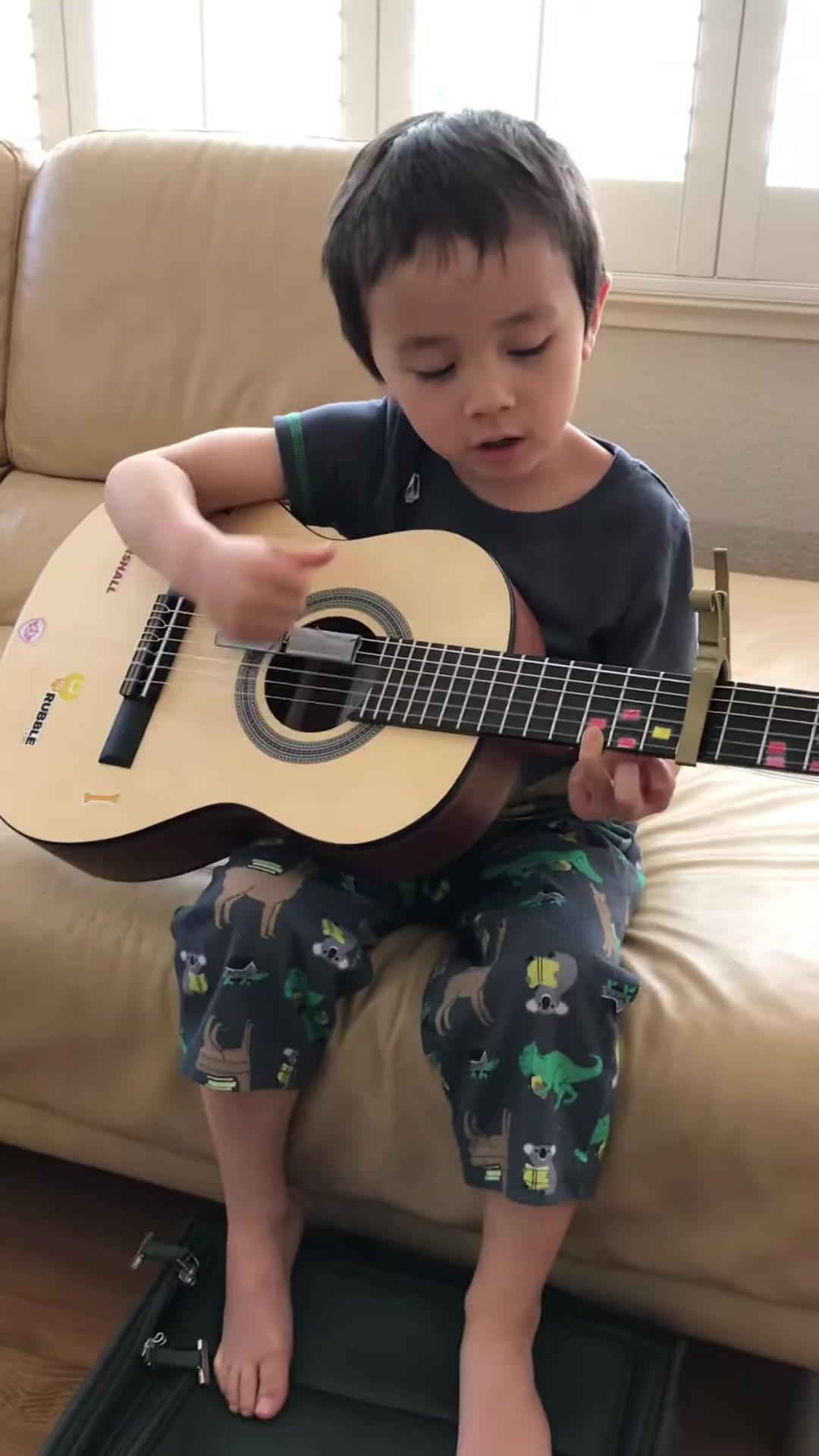
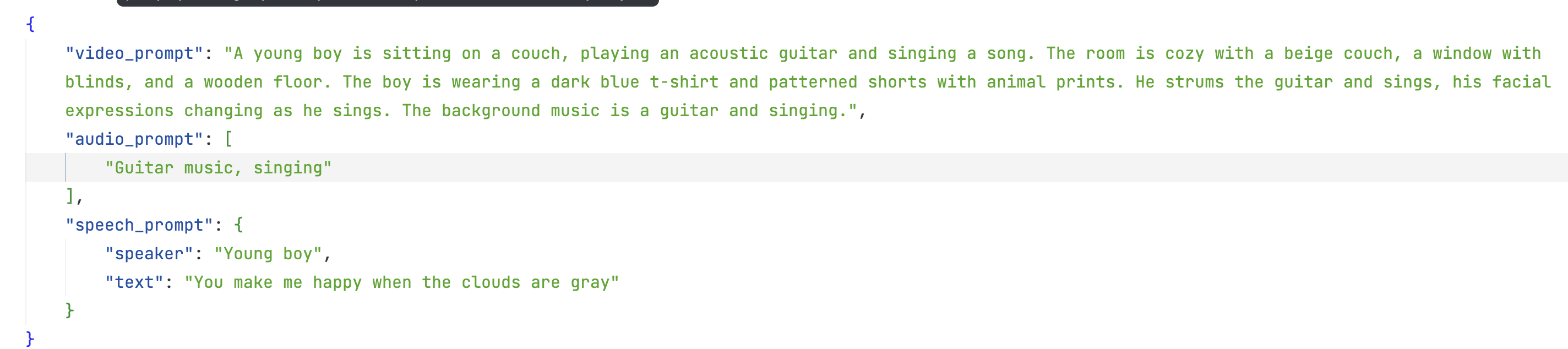
Data example:
Model architecture
Video model: Wan2.1-1.3B (30 layers)
Audio model: AceStep-3.5B (24 layers)
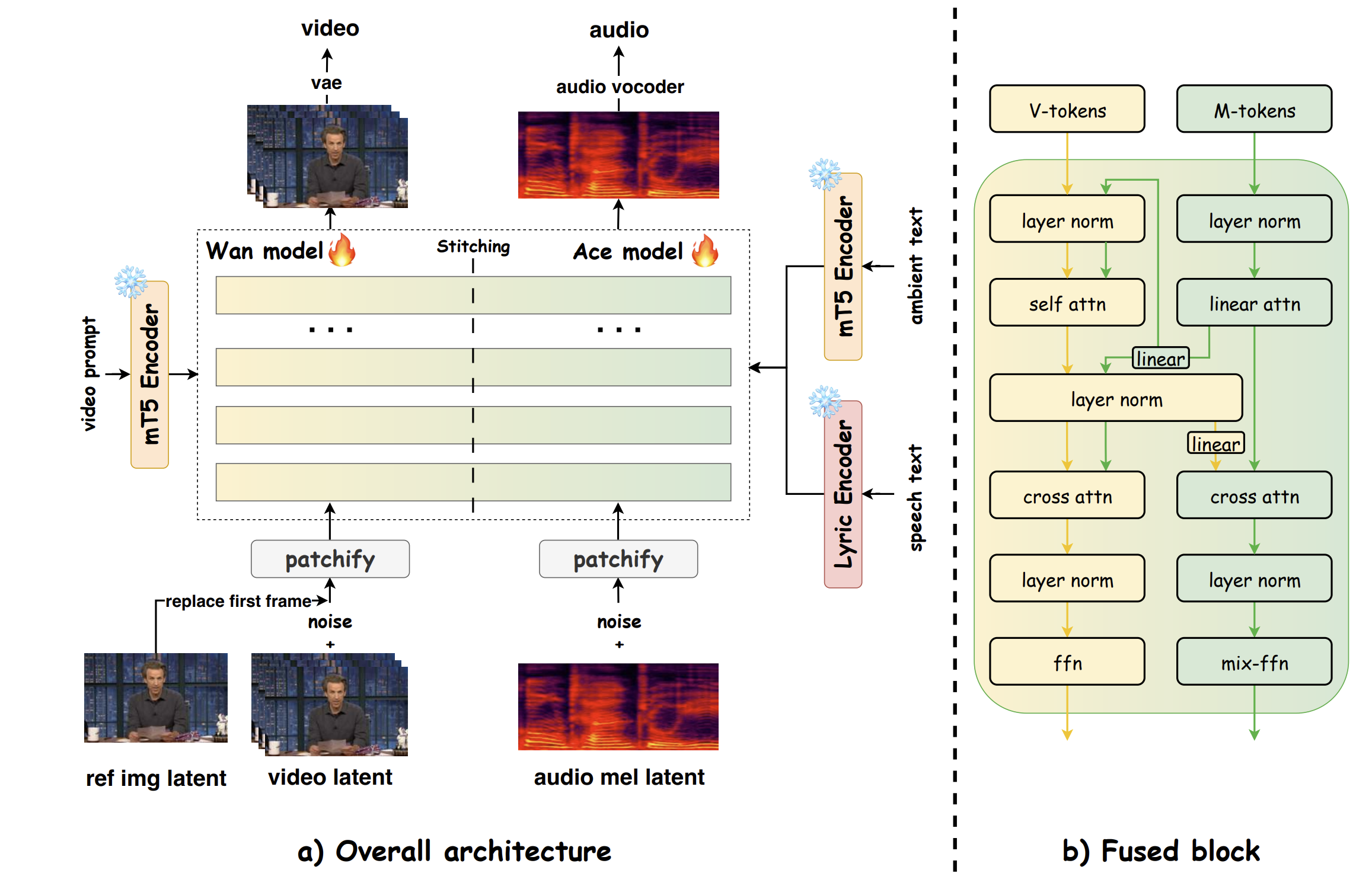
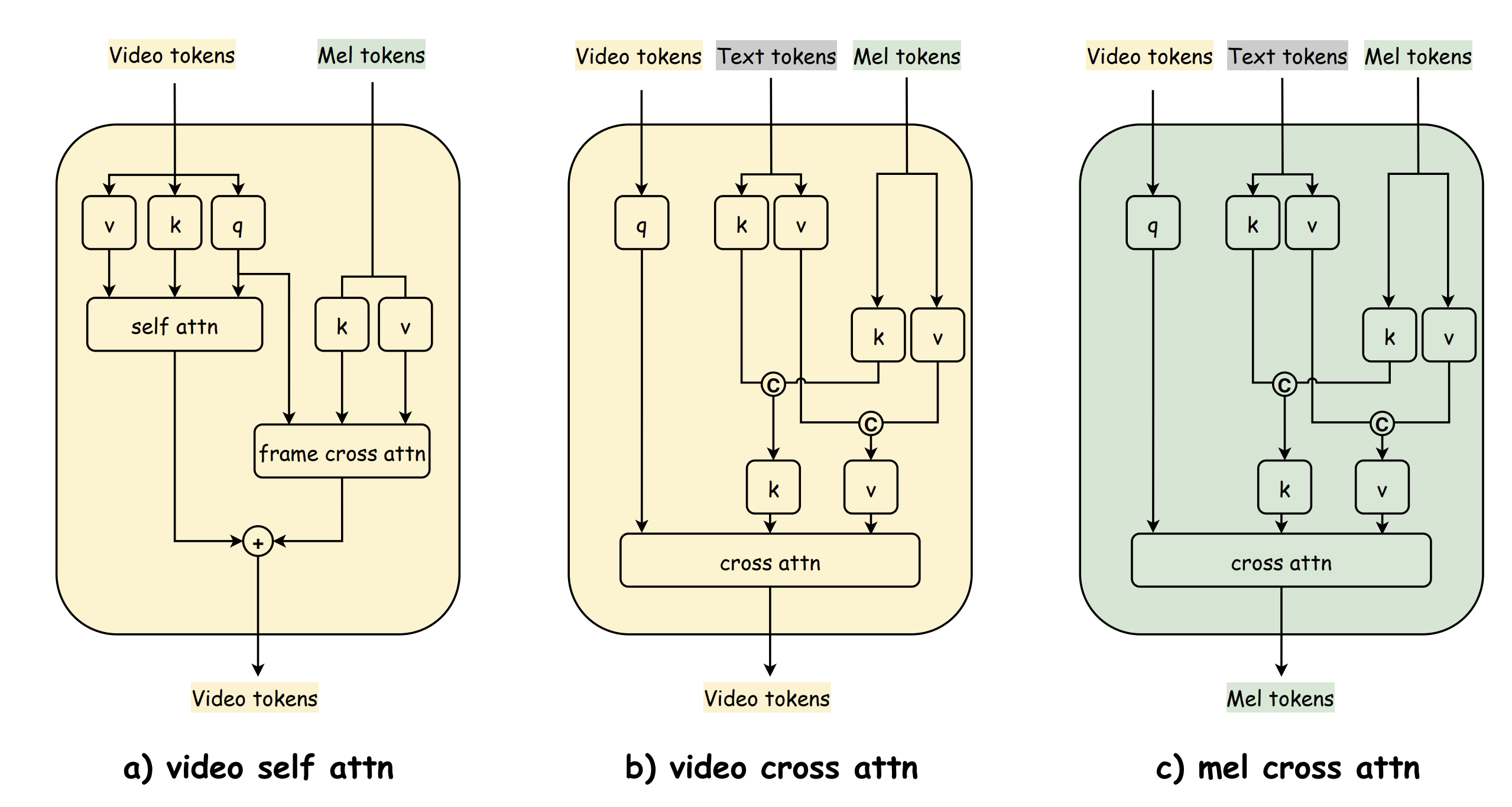
Training
$L=L_{\text{FM-video}}+L_{\text{FM-mel}}+\lambda_{\text{SSL}}\cdot L_{\text{SSL}}$
Base model pre-training: flow matching loss
Semantic alignment loss: $L_{\text{SSL}}=\frac{1}{2}(\cos\text{Sim}(h’_{audio}, h’_{MERT})+\cos\text{Sim}(h’_{audio},h’_{mHuBERT}))$
- For AudioSet \& VGGSound, employ a conditional loss scheme.

Key points
Audio-video Temporal alignment: 25fps video with 25.6KHz audio (Vary from the chosen of different base models)
Layer interpolation: Strategically insert new blocks at uniform intervals into the shallower of the two models until depths align.
- The parameters for each new block are initialized by linearly interpolating the weights of its immediately adjacent (bracketing) layers. (Benefit from residual connection?)
Independent noise sampling strategy
OVi [Character.AI]
https://arxiv\.org/abs/2510\.01284
Main idea: Stitching of Experts, but using Twin-backbone
Data Curation
Two corpus:
Audio-video corpus for learning modality alignment
Audio-only corpus for acoustic pretraining and fine-tuning: 12s \& 5s
Preprocess:
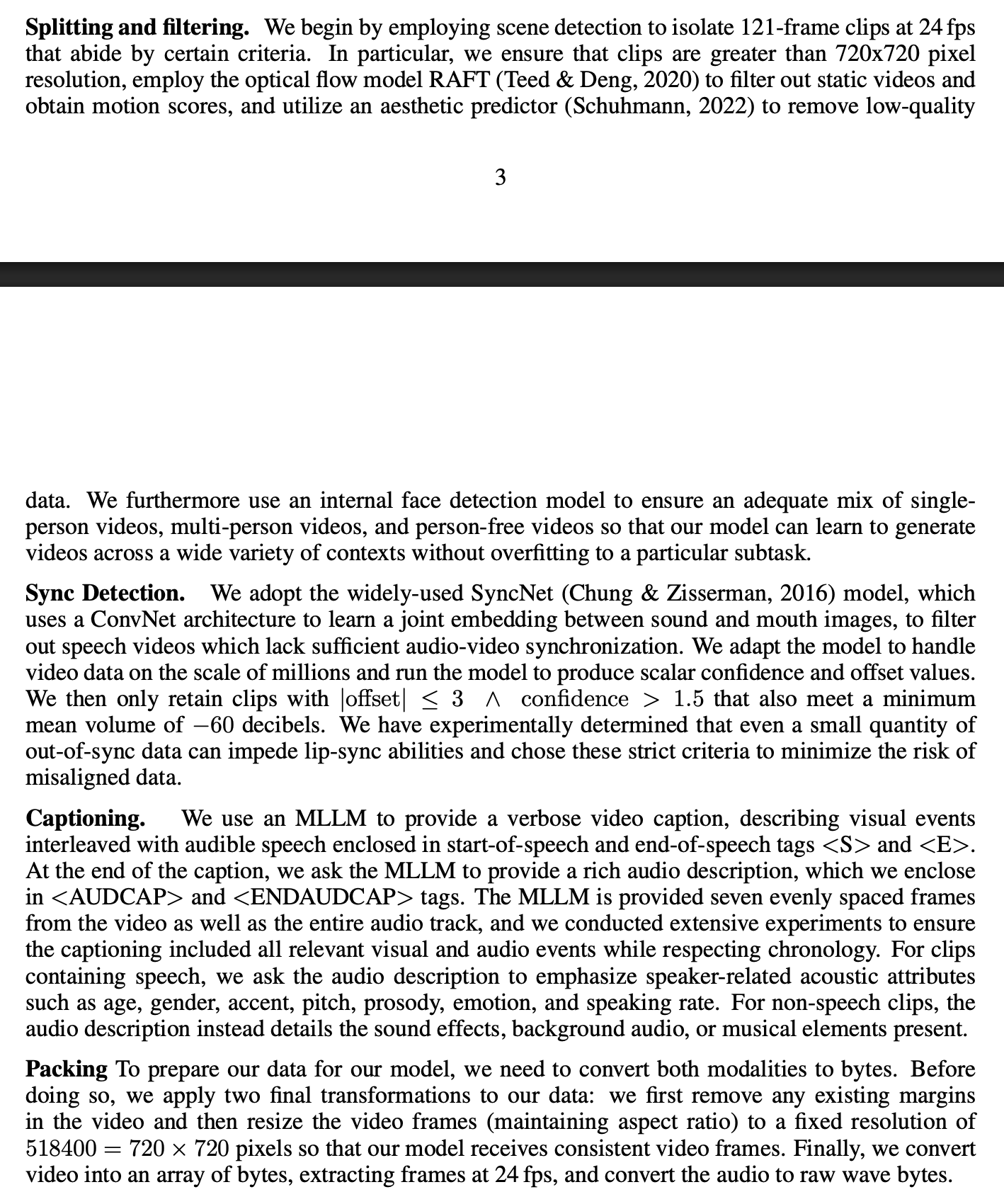
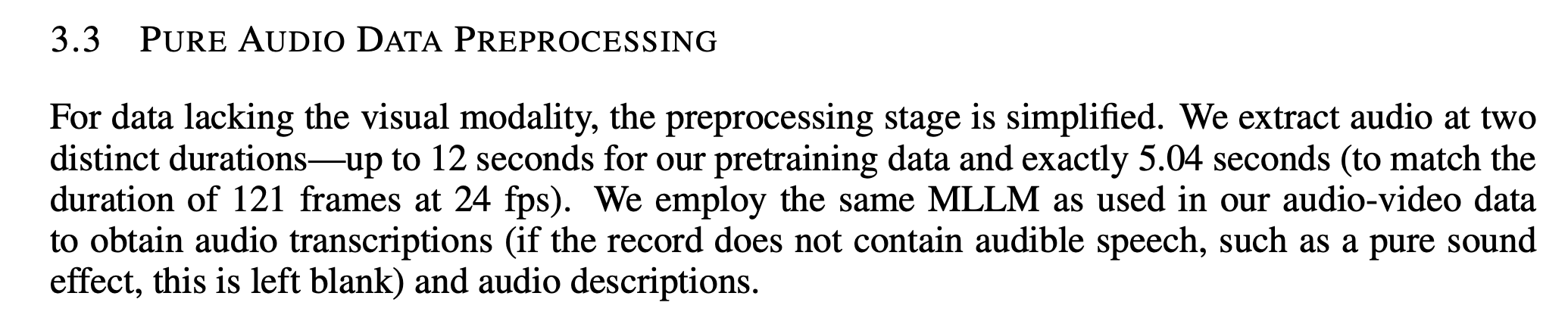
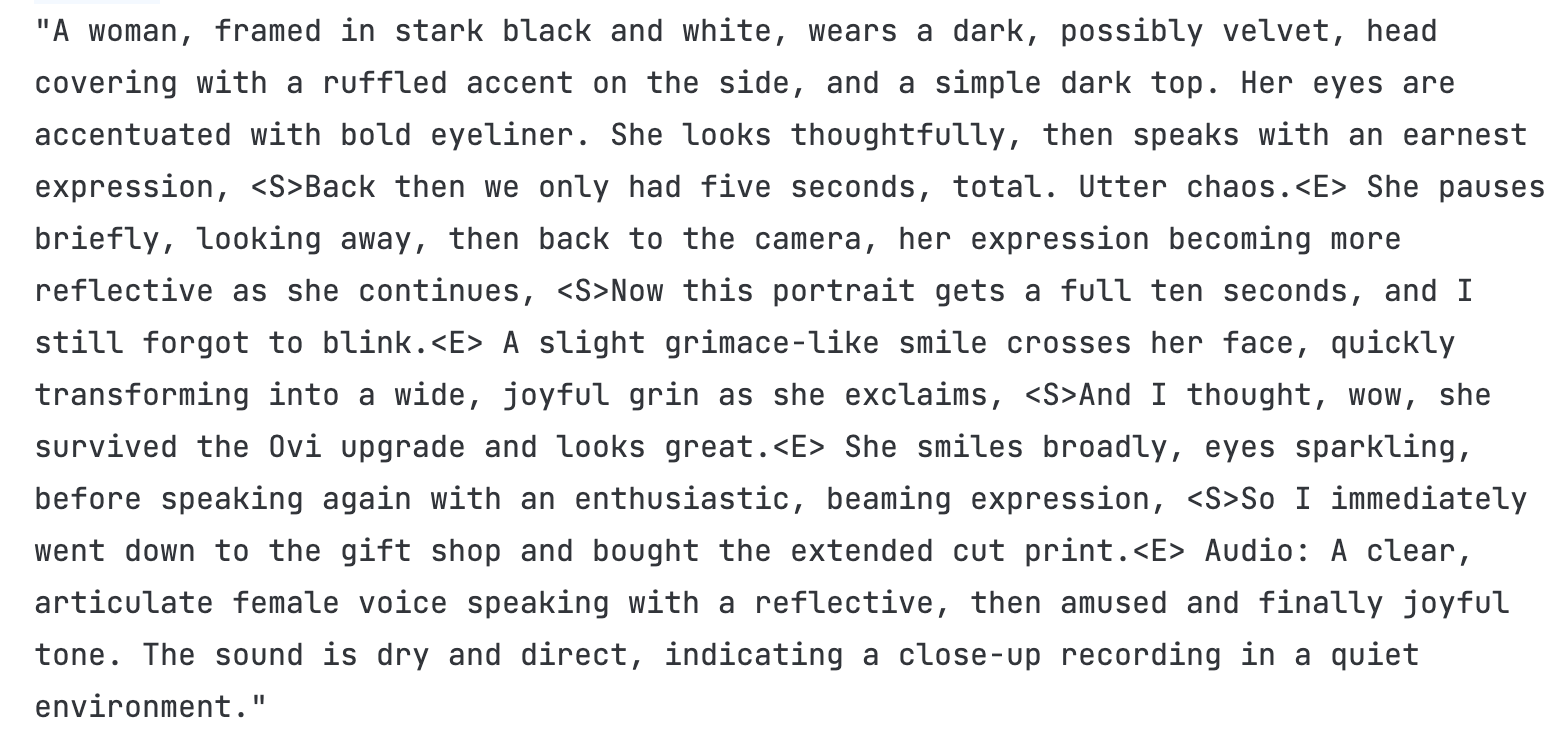
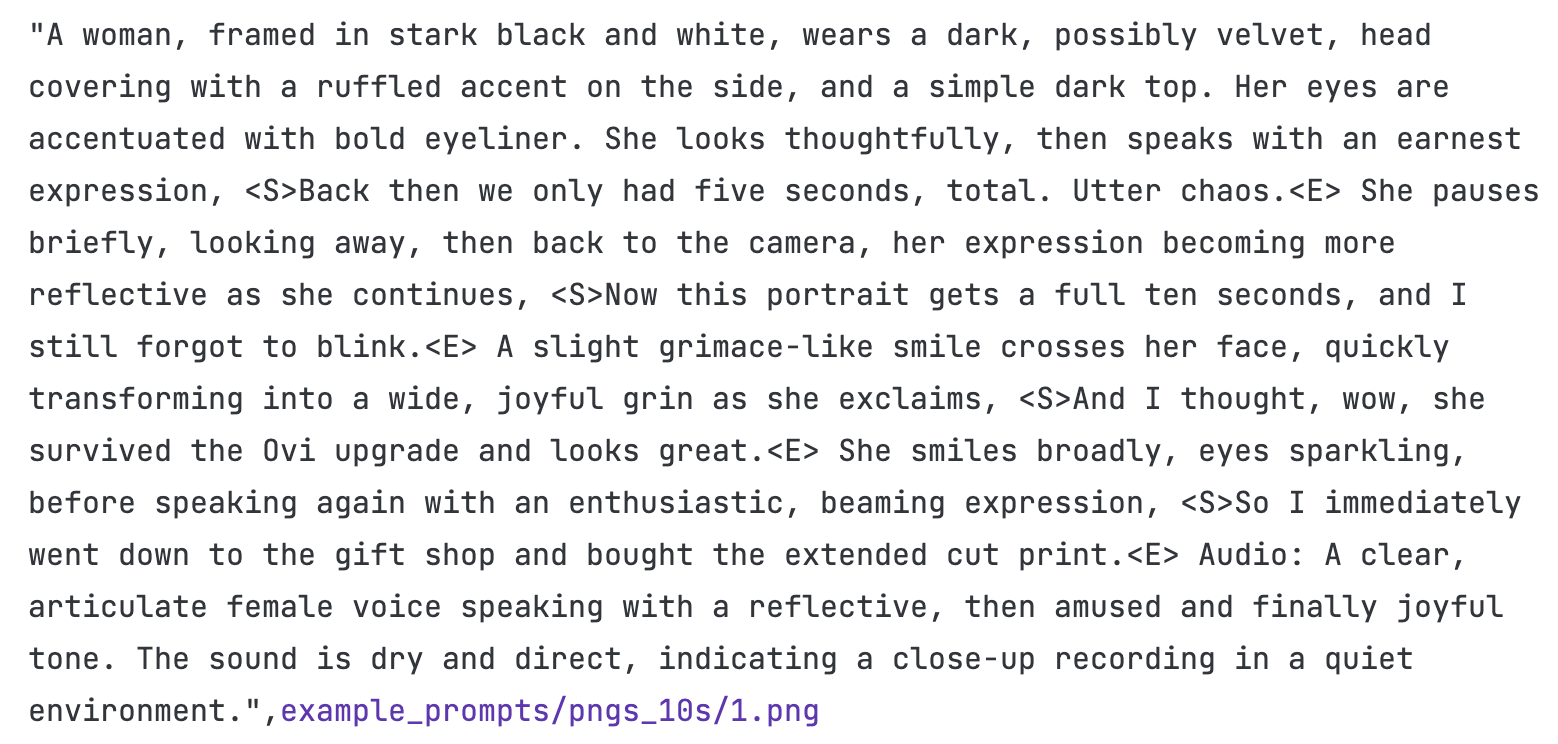
Data example:
Model architecture
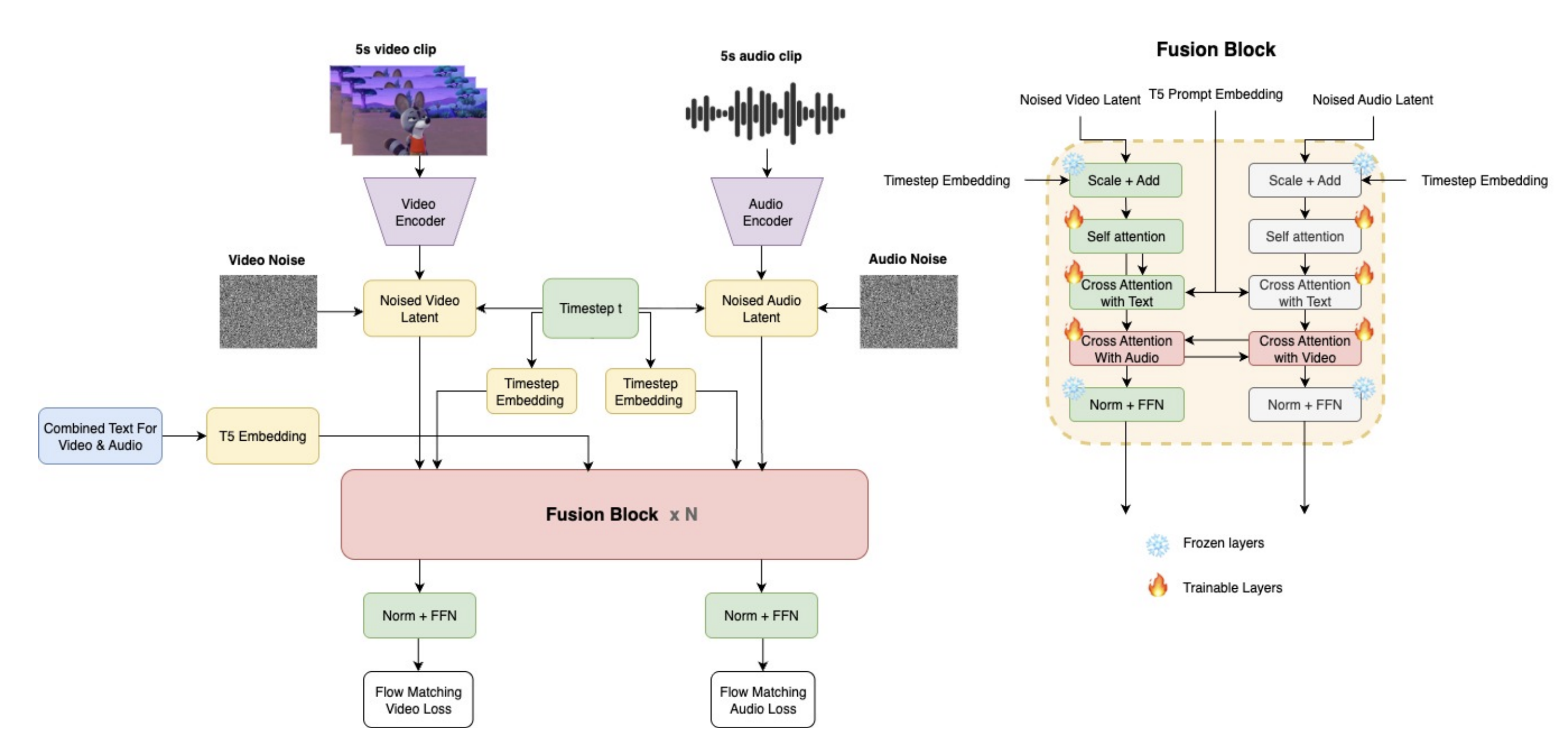
Twin backbone from Wan2.2-5B. The video branch is initialized from Wan2.2 5B, and an identical audio branch is trained from scratch.
Training
Audio model training
Audio dataflow: raw -> mel -> MMAudio VAE
Loss: flow matching
Stages
Audio pretraining: 100k hours audio up to 12s.
Audio fine-tuning: 5.04s audio
Audio-video model training
Initialization: load pretrained params, freeze all FFNs, initializing cross-modal attention from scratch.
Loss: flow matching. $L_{total}=\lambda_vL_{FM}^v+\lambda_aL_{FM}^a, \quad \lambda_v=0.85,\;\lambda_a=0.15$
Key Points
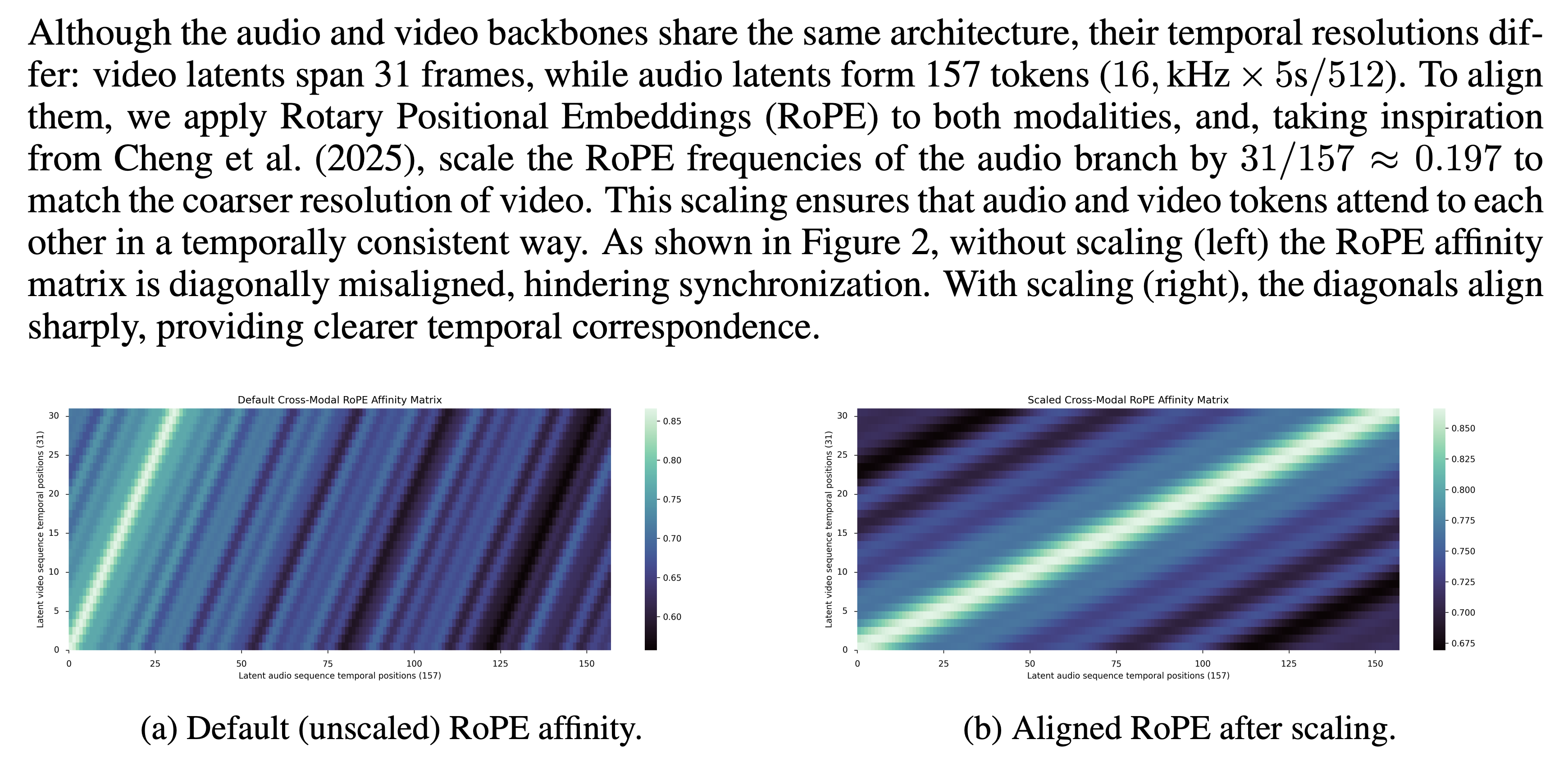
- Audio-Video temporal alignment: Apply RoPE scale to the audio branch by 31/157=0.197
- Two-stage training: Pretraining audio model, then fuse with video model by post-training.
JoVA [ByteDance]
https://arxiv\.org/abs/2512\.13677
Main idea: No additional fusion
Data Curation
- Audio 2.4k hours + Audio-Video 1.3k hours + Speech-Video 0.7k hours
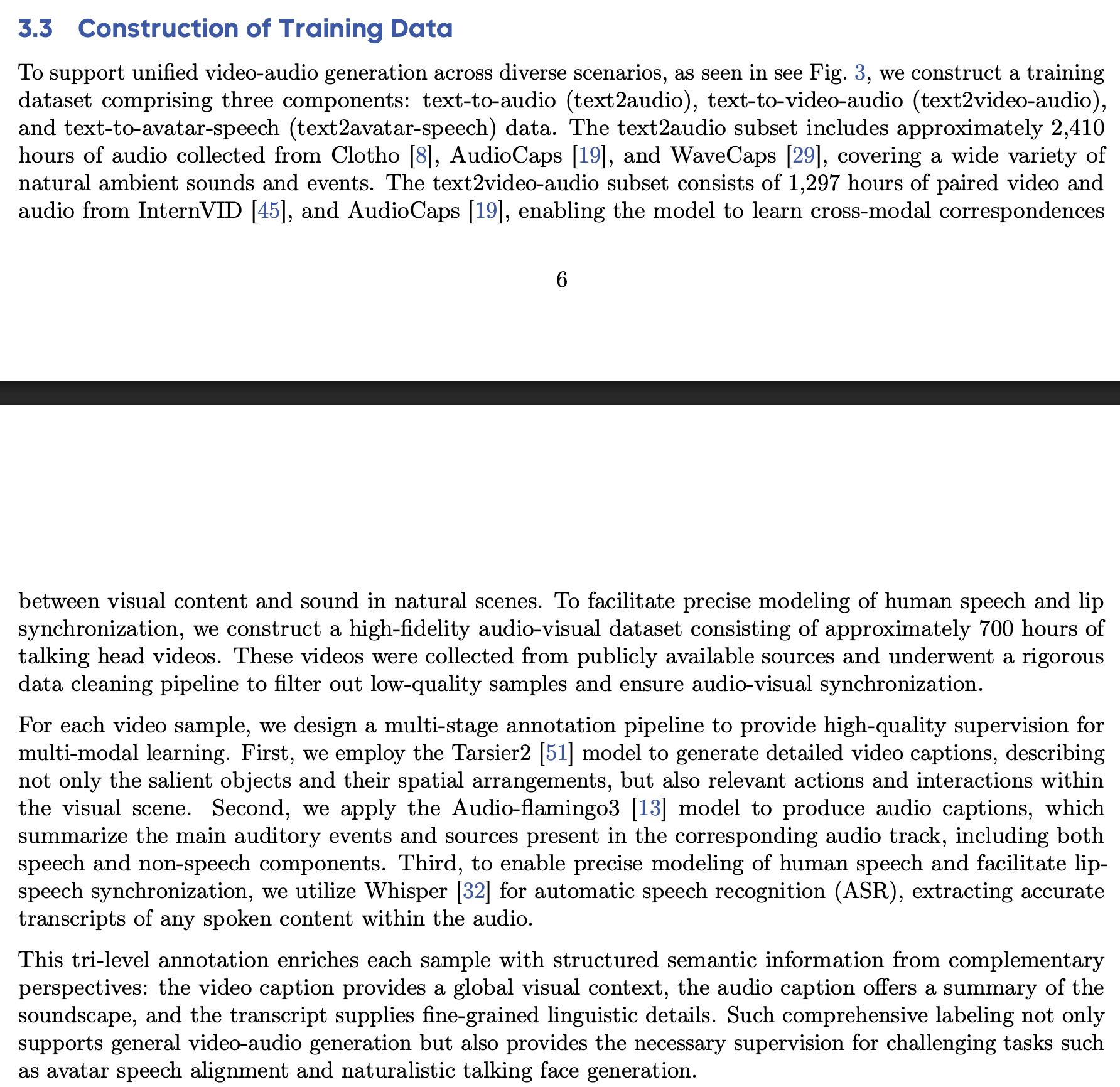
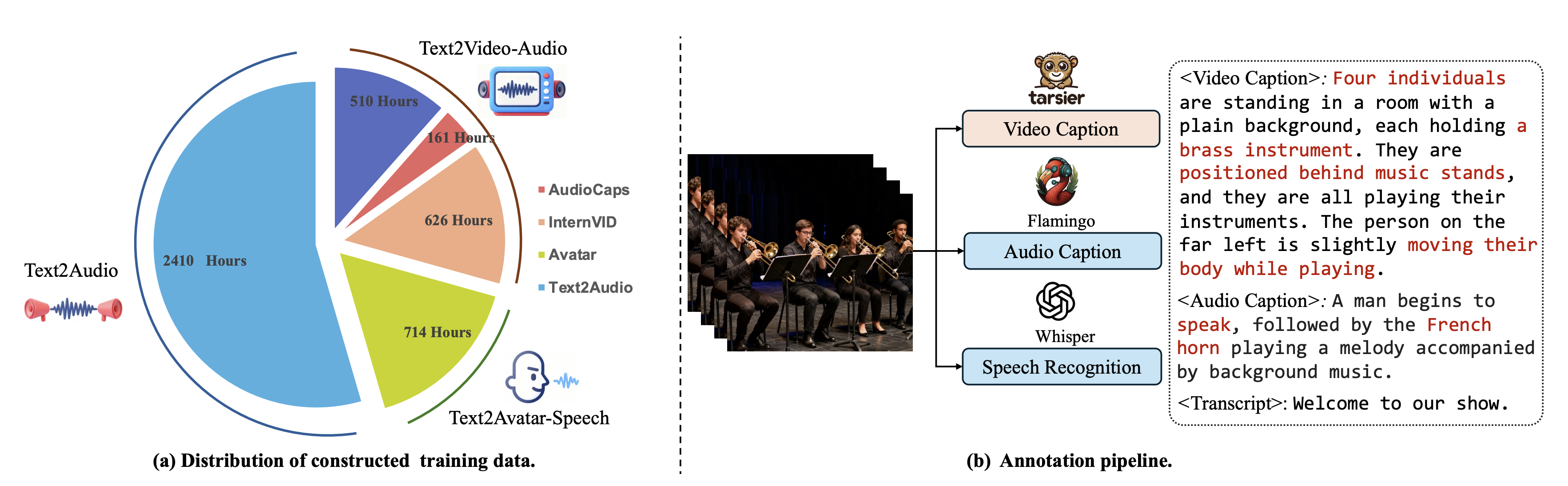
Model Structure
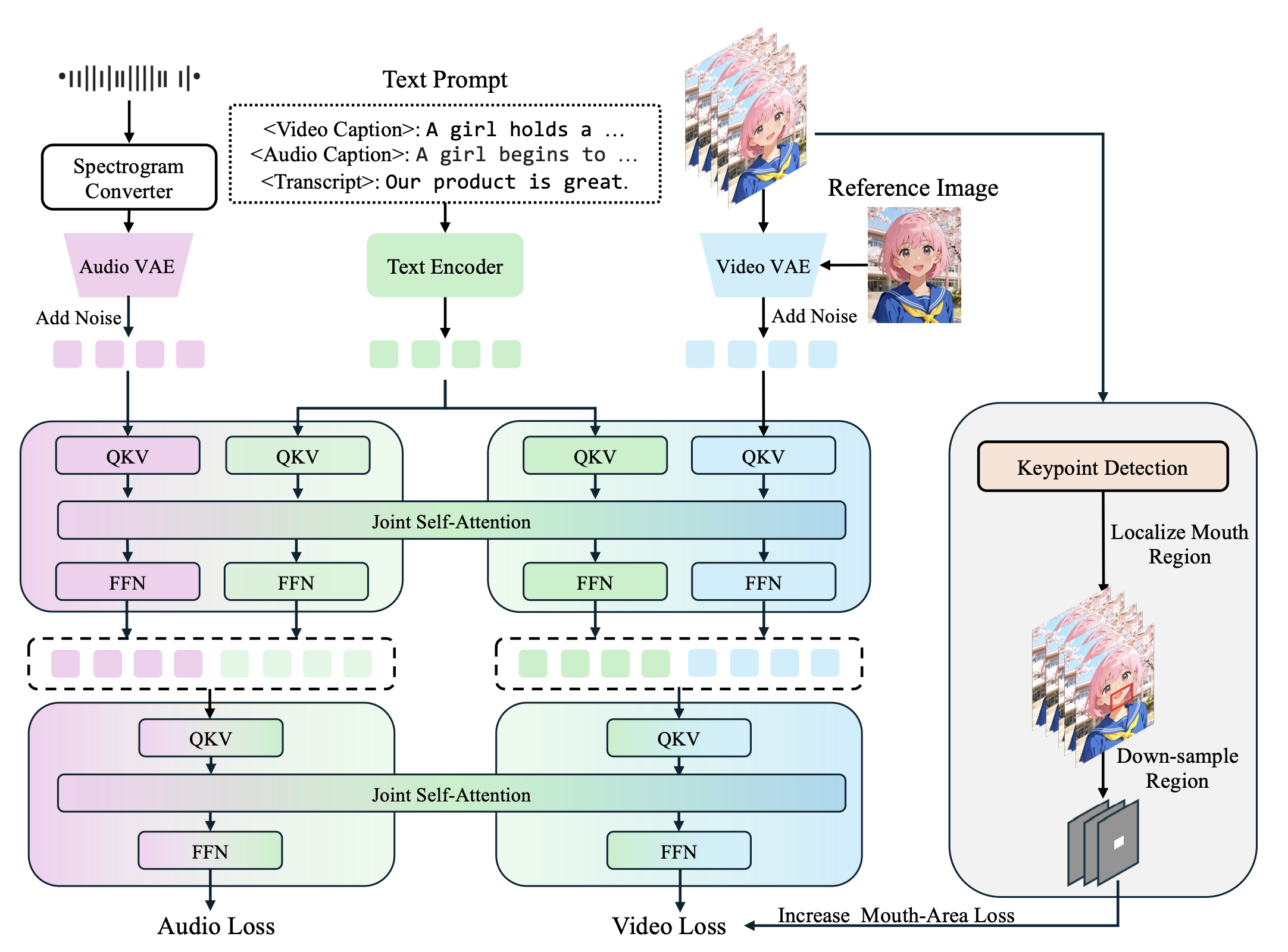
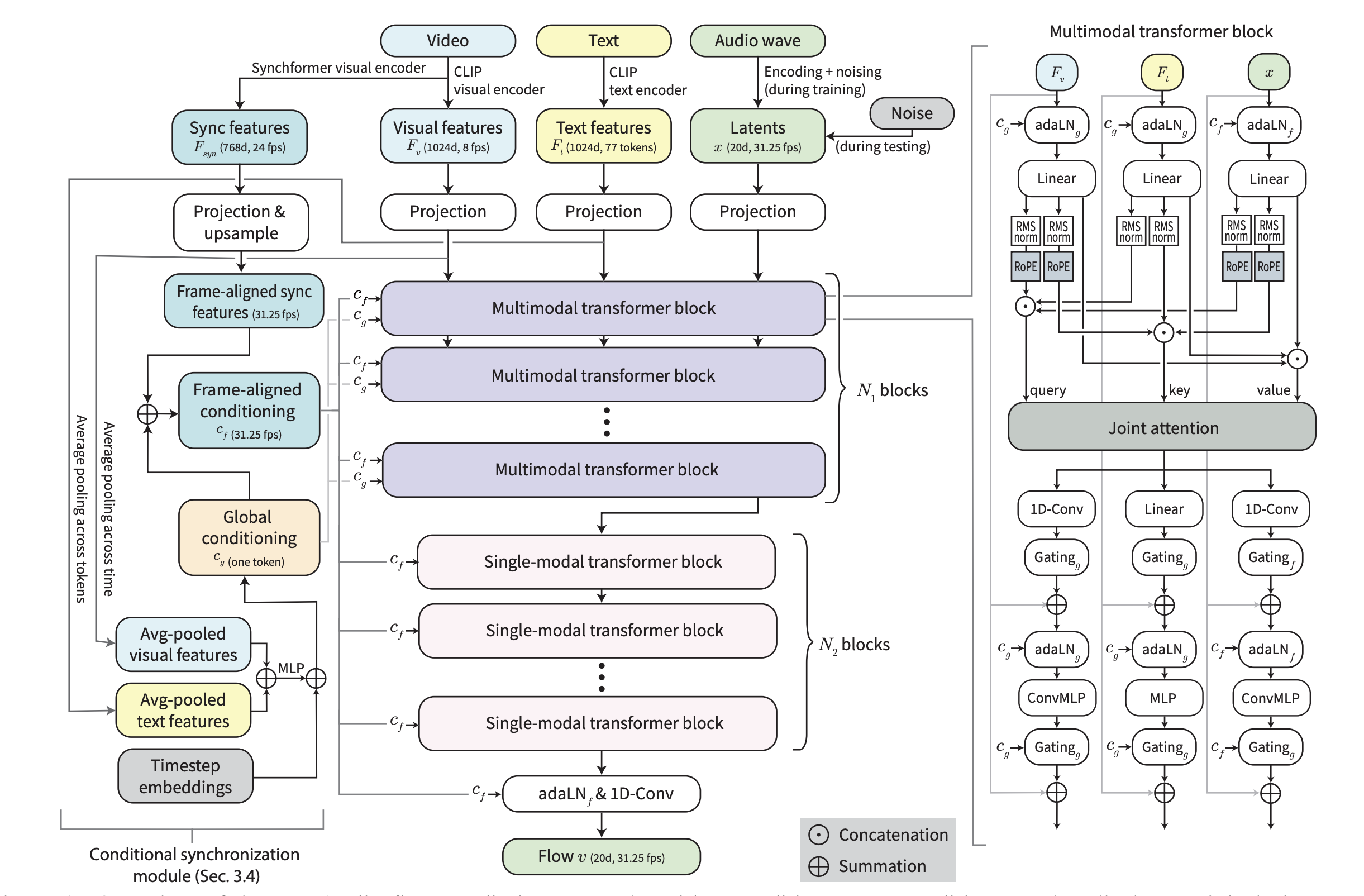
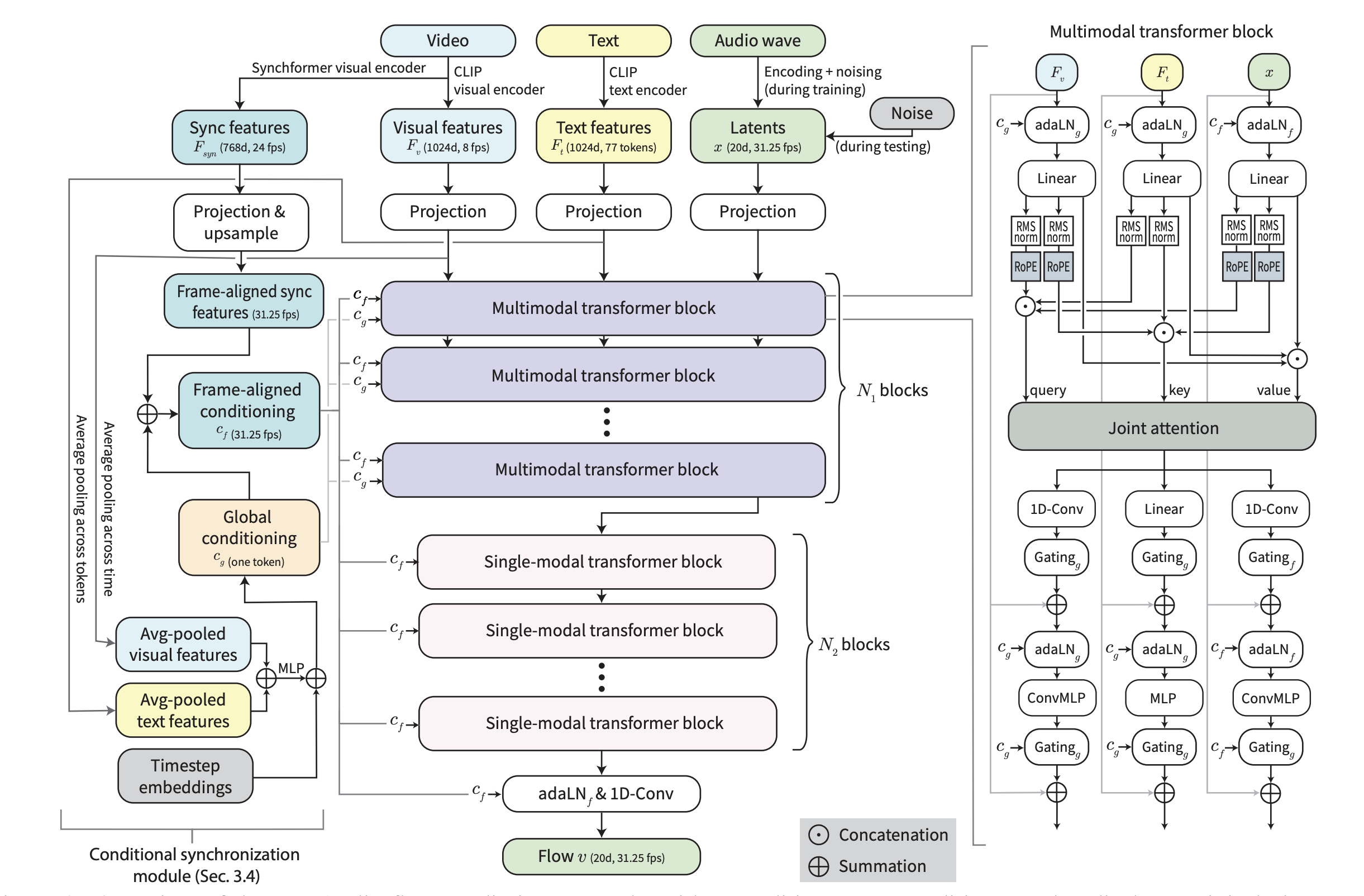
Structure of Waver, helps to understand why JoVA uses “Joint Self-Attention”
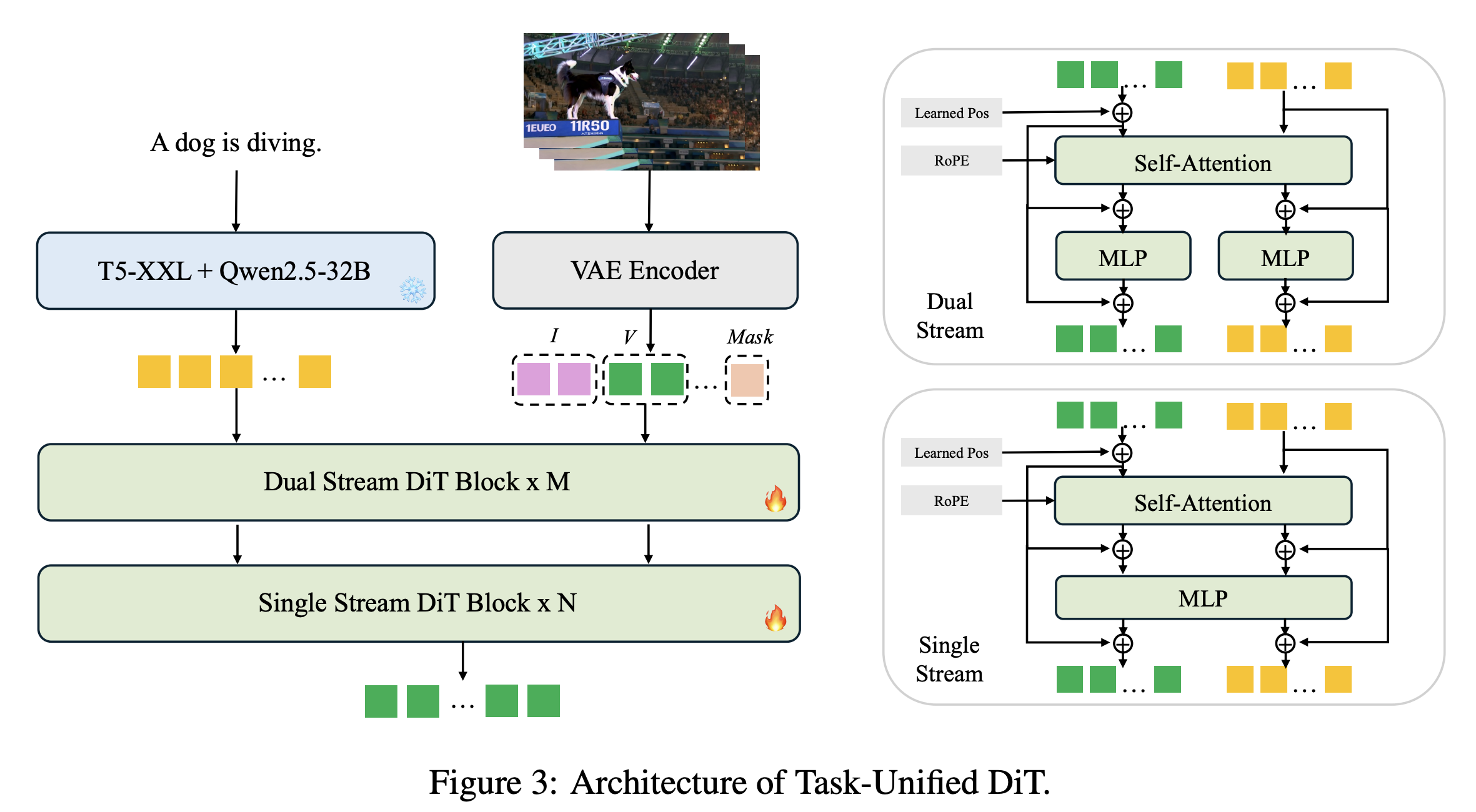
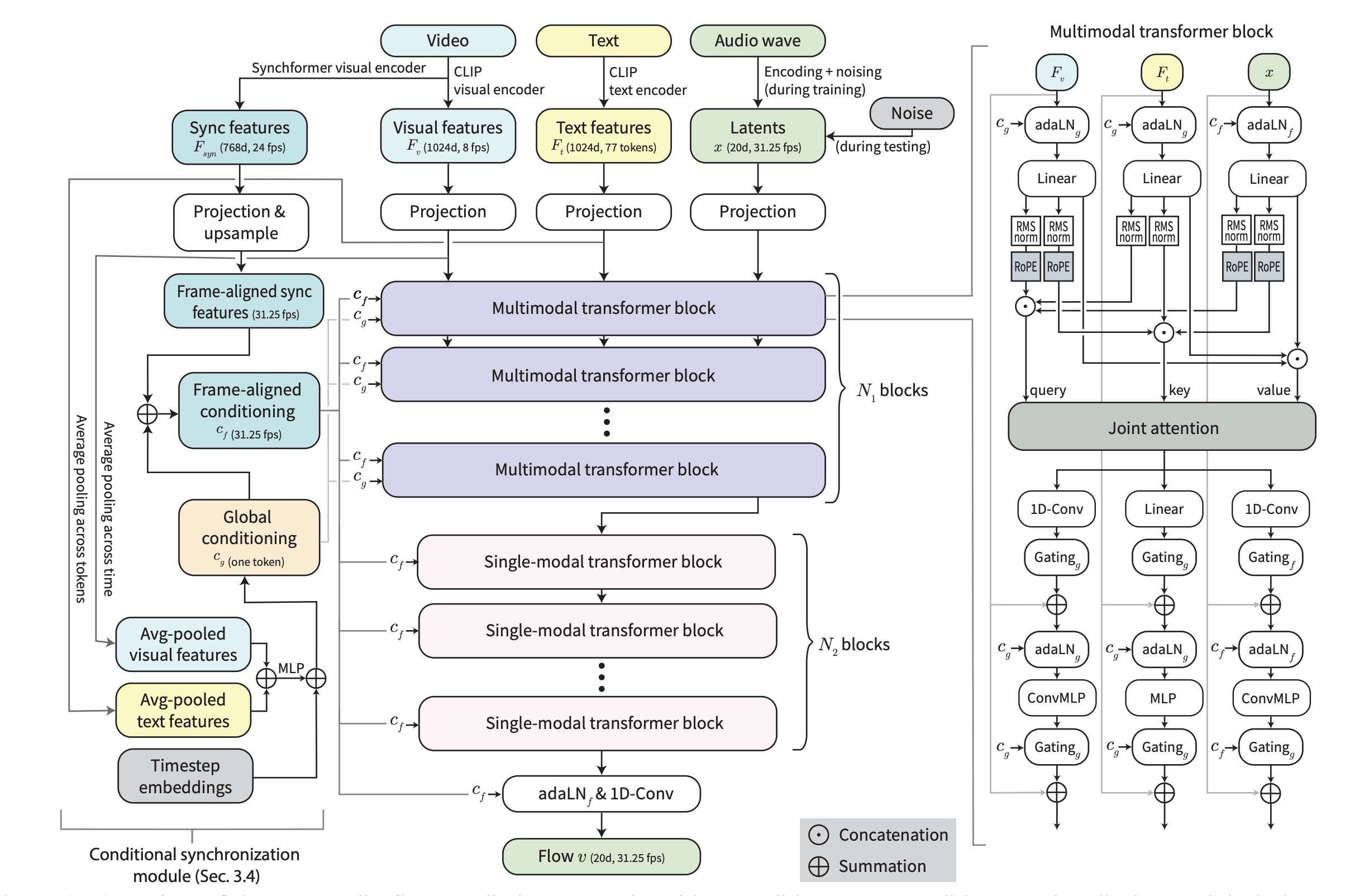
Structure of MMAudio, helps to understand what exactly “Joint-Attention” is
Key points
The proposal of the so-called “Join Self-Attention” actually aims to inherit the training methodology of Waver,
Audio-Video temporal alignment: Apply RoPE scale to the audio branch by 31/157=0.197
Two-stage training: Pretraining audio model, then fuse with video model by post-training.
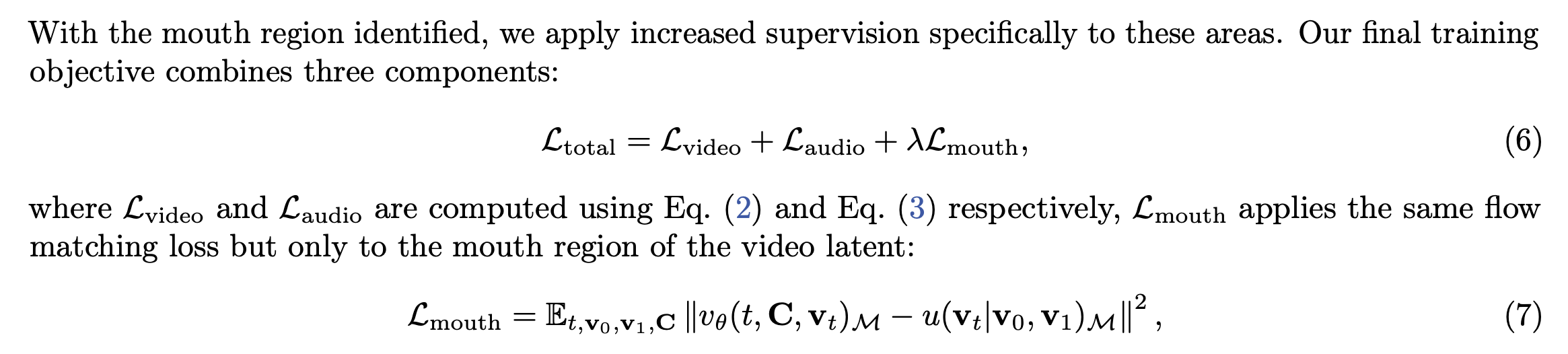
Mouth-aware supervision: Boost mouth region’s loss (need to align with video VAE latent space first).
[TBD] Multi-stage
Audio-driven Video Generation
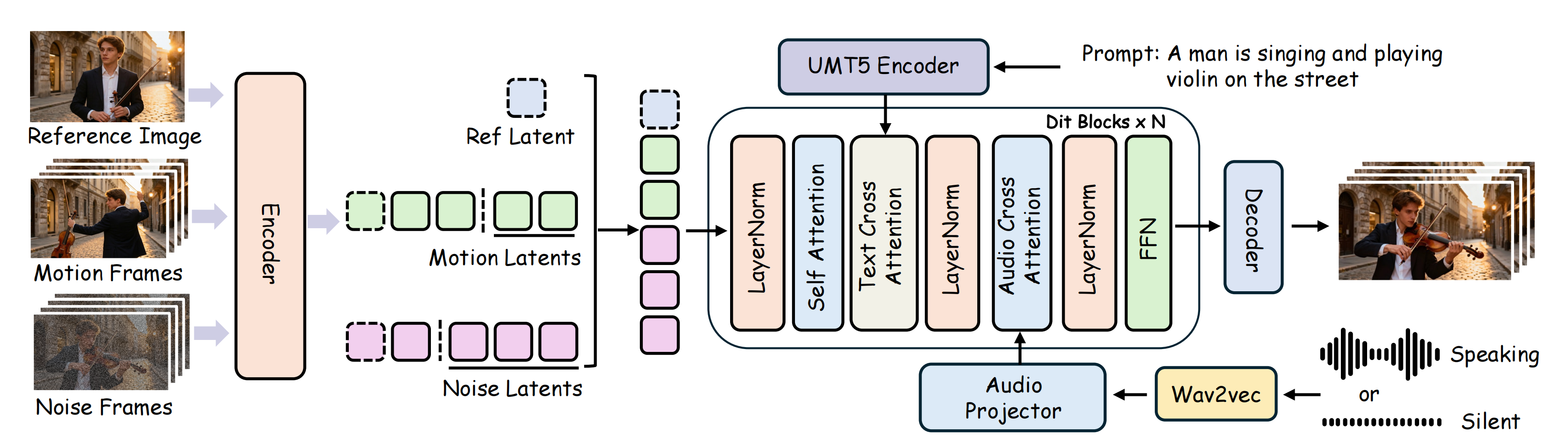
LongCat-Video-Avatar
Important inspiration: sometimes multi-task training settings serve the original task.
HuMo supports generation with no audio
LongCat supports video continuation task
Model structure
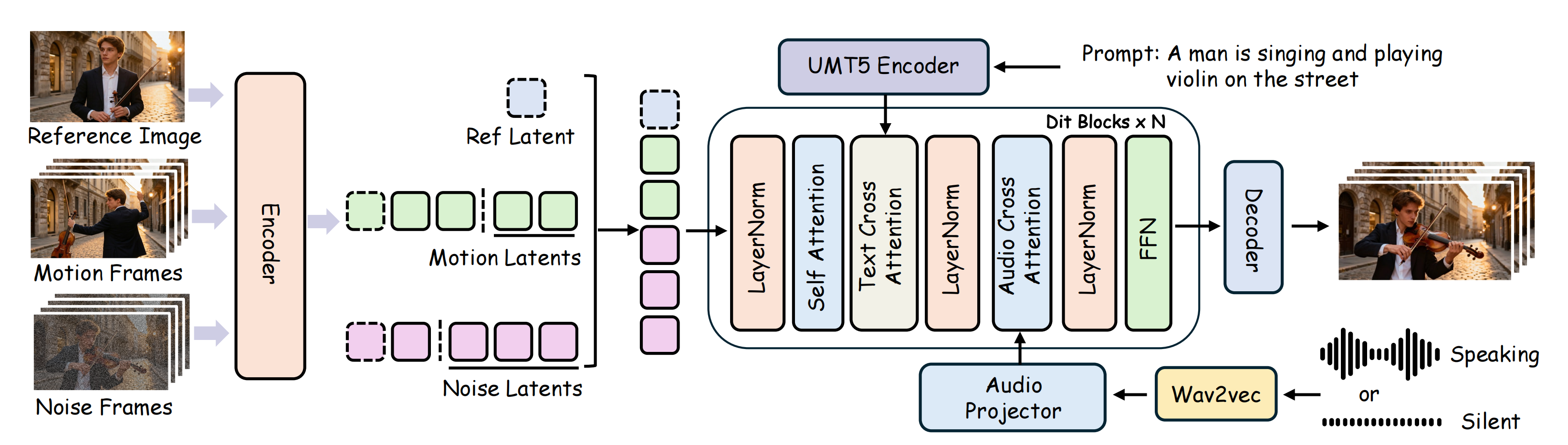
Initialize from a pretrained video diffusion model
Insert audio cross-attention
- Directly adding this layer causes training instability and prevents the model from effectively aligning audio signals with corresponding mouth movements -> introduce an Adaptive Layer Normalization (adaLN) module before each audio cross-attention layer.
Audio projector: to temporally compress the audio embeddings.
Training objective: $\epsilon=\epsilon_\theta(z_t,t,c_{\text{text}}, c_{\text{audio}})$
Key points
- Disentangled unconditional guidance: model cannot distinguish between unconditional input and silent audio

Reference skip attention
Cross-chunk Latent Stitching
Video-driven Audio Generation
MMAudio
Model architecture